
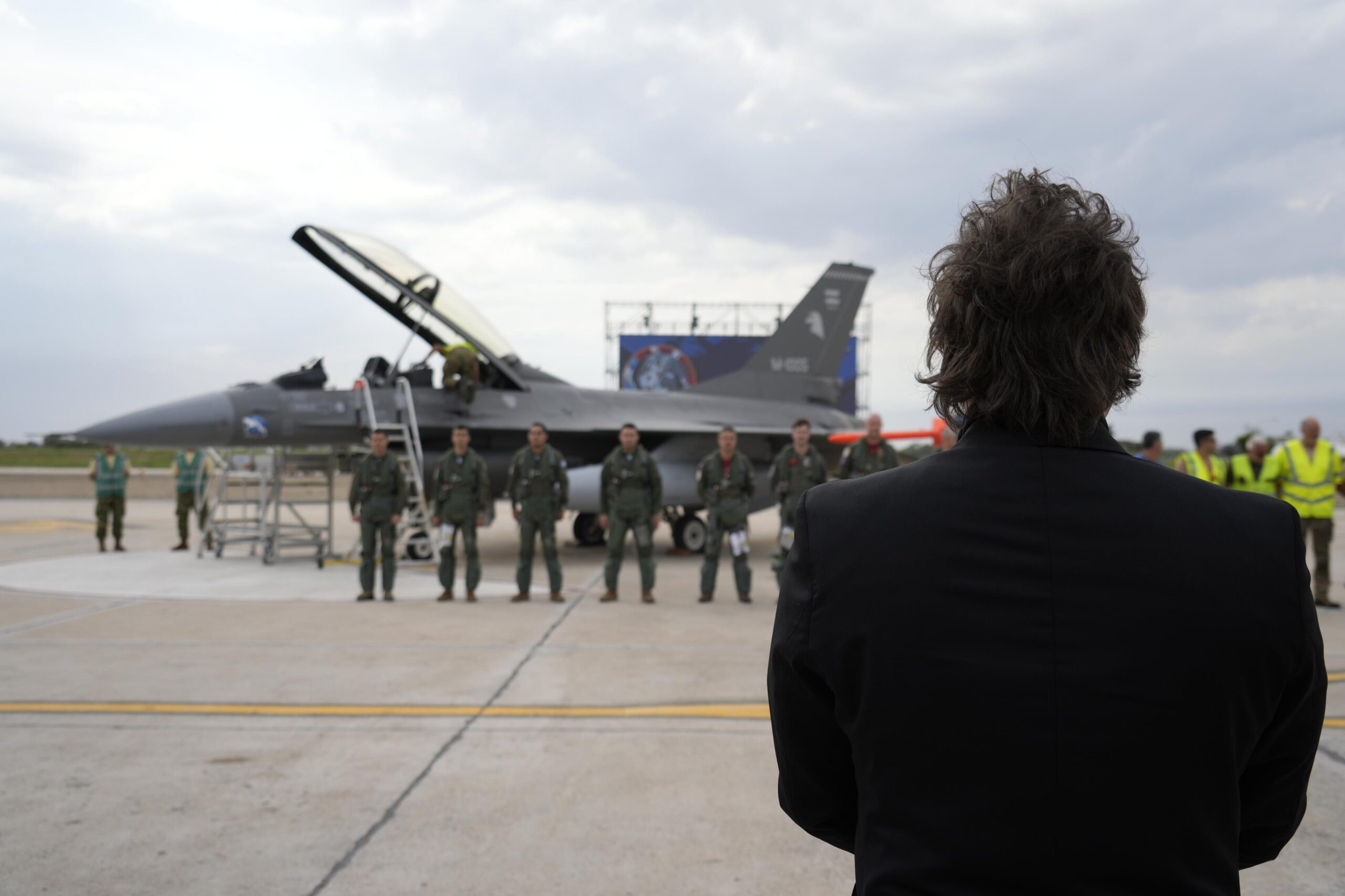

Buenos Aires, Argentina — The arrival of Argentina’s first U.S.-made F-16 fighter jets in December marked a historic shift in the country’s defense policy. Brokered through Denmark and backed by Washington, the deal signals a clear realignment under President Javier Milei, formally closing the door on other alternatives offered by China and India.
The timing coincides with a renewed U.S. focus on hemispheric security under President Donald Trump, who has made Latin America a top priority in what analysts call the “Donroe Doctrine,” his modern corollary to the 19th century Monroe Doctrine, which opposed any influence outside the U.S. in the Western Hemisphere. This approach seeks to counter China’s expanding economic, infrastructure, and strategic cooperation with the region, which has grown steadily over the past decade.
Francisco Cafiero, a former Argentine Deputy Defense Minister (2019–2023), played a central role in negotiations before Milei’s inauguration, when the Chinese JF-17 jets were considered a “viable option” due to their potential to strengthen Argentina’s deterrence in the South Atlantic and the financing opportunities they offered.
In an interview with Argentina Reports, he stated that the final decision to purchase F-16s was as much political as technical. “Strategic decisions, such as military equipment, are political. This was clearly a political decision by Milei, to align with Washington’s position. What he did with this was anticipate the guidelines that the United States later published within the framework of its national security strategy,” Cafiero said, highlighting that the jets represent a long-term commitment involving weapons systems, training, and maintenance.

Before Milei’s administration, Argentina had evaluated multiple options, including South Korea’s FA-50, Russia’s MiG-35 (suspended due to the Ukraine war), India’s Tejas, and China’s JF-17. Cafiero explained that under the Alberto Fernández government, the recommendation was to go with the Chinese JF-17, which offered technology transfer, financing, and operational autonomy. “We conducted all evaluations… Our advice was to go with the JF-17 as the best deterrence option. But elections entered the picture before a final decision could be taken,” he said.
Although Cafiero acknowledged that about 90% of Argentina’s military equipment comes from the U.S., he considered that the Chinese JF-17 was a sophisticated alternative, with capabilities that could have enhanced Argentina’s regional presence.
“It was a very good offer because it is a complex fourth-and-a-half generation weapons system, brand new, with 100% Chinese technology without British components,” he said, alluding to the ban on buying British military equipment since the Malvinas War in 1982.
“Though The F-16 has six British components that can be substituted with American ones, the Chinese system would have given Argentina full autonomy and a weapons system entirely unknown in Latin America. It also offered financing and technology transfer, allowing local defense organisms to perform maintenance tasks,” he added. However, choosing the F-16 aligned Argentina with U.S. strategic interests in the region, reinforcing Washington’s stance against its superpower competitor amid global competition for critical resources, including rare earth minerals, oil, and gas.
Operational and financial constraints were also central to Cafiero’s analysis. He noted that flying an F-16 fully equipped costs between $20,000 and $22,000 per hour, and Argentina may not have the budget to acquire all necessary weapons or maintain the fleet at full capacity. The first six jets arrived out of a total of 24 planned over four years, with an estimated total investment of around $650 million. “Two key questions remain: will the U.S. have the political willingness to sell all the armaments Argentina eventually wants, and does Argentina have the budget?” Cafiero asked.
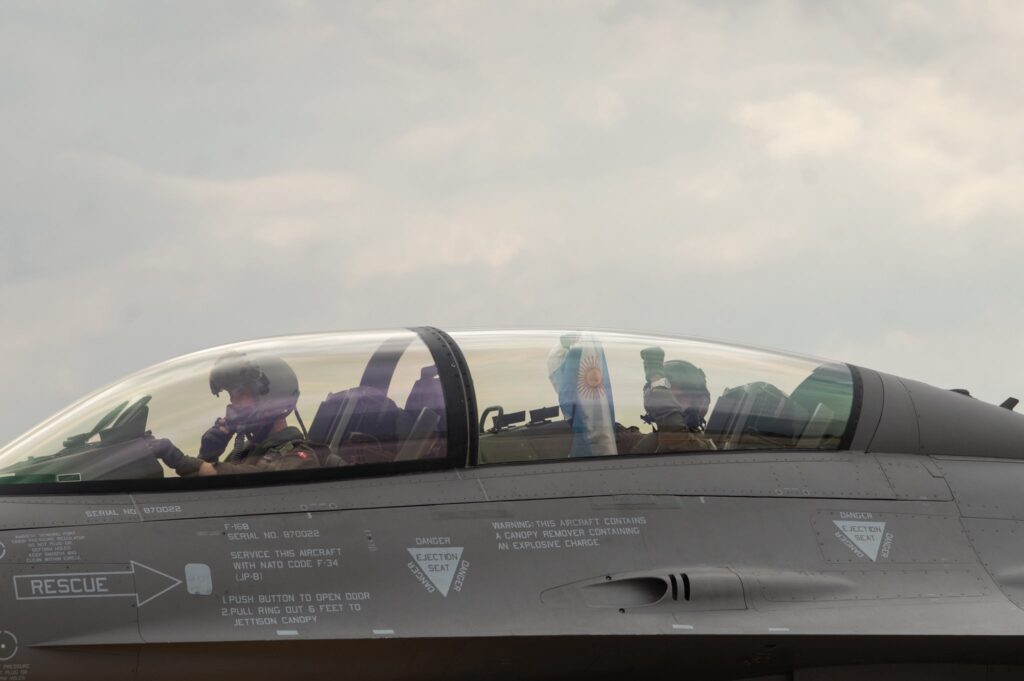
The Milei administration has framed the purchase in both strategic and symbolic terms. During a ceremony in Río Cuarto, Córdoba, Milei said, “These aircraft are a symbol of the Argentina we are building. Today more than ever, we can say that the forces of heaven are with us,” highlighting the rhetorical, sometimes mystical tone he often adds to speeches. Former Defense Minister Luis Petri, who oversaw the final stages of the acquisition, described it as “the most important military purchase in the last 40 years,” highlighting that the jets restore Argentina’s supersonic capabilities—a long-standing “debt” since former President Mauricio Macri dismantled the Mirage fleet in 2017.
Cafiero stressed that Milei’s decision represents a break with Argentina’s previous multilateral approach. “With Milei’s arrival, there was a profound shift in foreign and defense policy. The new government adopted an unconditional alignment with the U.S., partially with Israel, abandoning any balance or autonomy. This alignment exaggerates and consolidates a logic of dependency… Before Milei, Argentina pursued regional integration, multilateralism, and a realistic reading of a world in transition. That ended,” he said.
Energy security is another key factor in Washington’s interest in Argentina. Cafiero pointed to Vaca Muerta, one of the world’s largest unconventional shale oil and gas reserves, as a strategic asset. “Its gas reserves could provide over 150 years of energy autonomy for Argentina at current consumption. Oil, roughly 85 years. Its potential revenue is enormous—$30–40 billion annually over the next decade. Many analysts link U.S. intervention in Venezuela to energy. Could Vaca Muerta become a future target? Possibly,” he warned.
By choosing the F-16, Argentina not only upgrades its long-neglected air force but also sends a clear geopolitical signal. The jets restore deterrence, enhance control over national airspace, and embed Argentina within broader hemispheric security concerns, even as costs remain uncertain: not only political but regarding military maintenance and long-term armament acquisitions. The decision underscores a strategic pivot toward Washington amid intensifying U.S.-China competition in Latin America, marking a break from prior policies of regional cooperation and multilateralism.
Featured image: President Javier Milei received the new American F-16 fighter jets of the Argentine Air Force in December 2025.
Image credit: Oficina del Presidente de Argentina via X