
Buenos Aires, Argentina – This week, Argentina’s Official Statistics Institute (INDEC) reported that economic activity by 1.8% in the third quarter of the year, marking the second consecutive three-month decline and tipping the country into a technical recession.
The nation is also grappling with plummeting investor confidence and a weakening currency against the dollar.
The dismal economic data, which experts say is the result of the libertarian government’s fiscal policy, upsets Milei’s pledge to overhaul Argentina’s long-ailing economy.
INDEC’s recent report on economic activity found a 1.2% year-on-year contraction as of September.
Moreover, the country risk – a measure of how much more Argentina’s bonds yield compared to U.S. Treasury securities – tripled in the last four months. In July, it was at 402 points and now it has reached 1,067, making it more expensive for the country to borrow money.
The dollar has also gained value against the peso, which now sells for 1,625 to the dollar, a nominal record. This time last year, the exchange rate was around 1,447.
Guido Zack, doctor in economic analysis and director of Fundar, a Buenos Aires-based development think tank, told Latin America Reports that stagnation has been the rule, not the exception, under Milei.
“When Milei took office, he arrives with a strong adjustment, with a very high devaluation that generates a recession in the first half of 2024; in the second half, there is a recovery, but the recovery is interrupted in February 2025, and from that moment on, the economy does not grow,” recounted Zack.
The expert noted it is likely that the fourth quarter will see growth compared to the third, which would imply the end of the technical recession. However, he argues that will not signal the end of Argentina’s economic stagnation.
For Zack, the main culprit of the delicate situation in Argentina is government policy, which he says is stuck in a cycle of fiscal adjustment to reduce the deficit which, in turn, reduces economic activity.
“That is what causes a drop in revenue and an additional need for a new adjustment to maintain budgetary balance and fiscal surplus,” said the analyst.
Zack also explained that the government’s fiscal conservatism, alongside the peso’s depreciation, have led to a rise in Argentina’s dollar costs. This primarily affects private companies in the construction, mining, and manufacturing sectors, which are unable to sustain the tax burden and the high costs associated with importing goods or services.
As Zack notes, these three sectors are major generators of formal employment in Argentina.
“What new sectors will be hit by 2027? Basically the same ones that have been hit in recent years, which are the major job generators”, commented Zack.
Since the start of Javier Milei’s administration in December 2023, 32,000 companies have closed, and 386,000 jobs have been lost as a result of this situation.
The government’s response

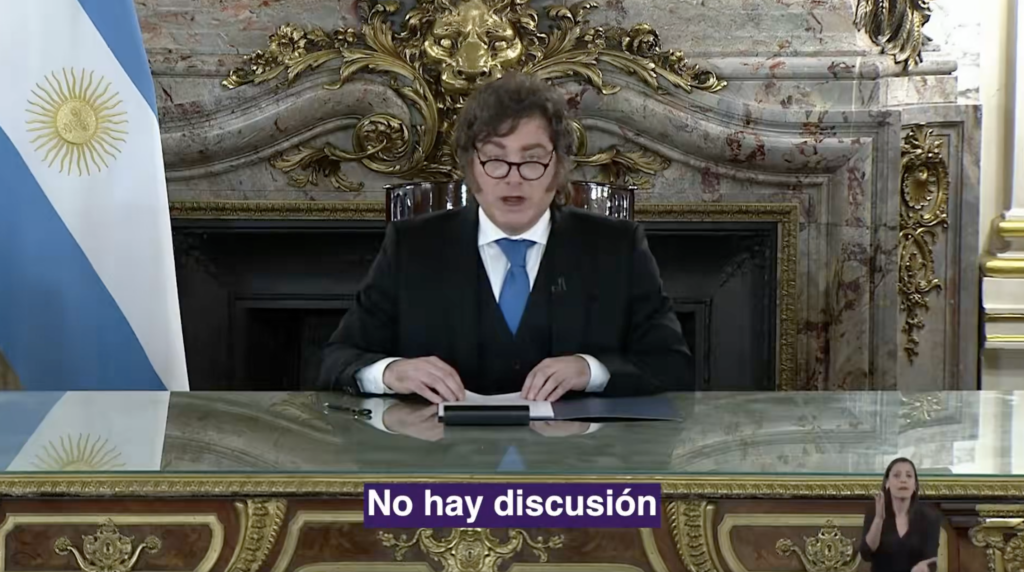
“The definition of a technical recession is a mere arbitrary definition,” Milei wrote on X in response to the latest economic data.
But his Minister of Economy, Luis Caputo, admitted that the economy had grown less than the libertarian government would have liked in an interview with the A24 channel on Wednesday.
Nevertheless, Caputo and Milei dismissed the currency and investor confidence problems.
“I am not concerned about the rise of the dollar,” said the Minister of Economy.
He argued the peso’s decline is due to external factors, namely “a period of global crisis that has had a “worldwide” impact. But critics note not all countries in the region were hit as Argentina was.
Government sources also said the president believes the markets overreacted and that the situation will normalize in the coming weeks.
This Thursday, the Treasury renewed peso-denominated debt maturities for 25.4 trillion pesos. The operation will allow it to avoid an injection of pesos into the country. However, if investors do not reinvest, the decline in consumption and the trade deficit will continue to grow. This could affect inflation and the exchange rate.
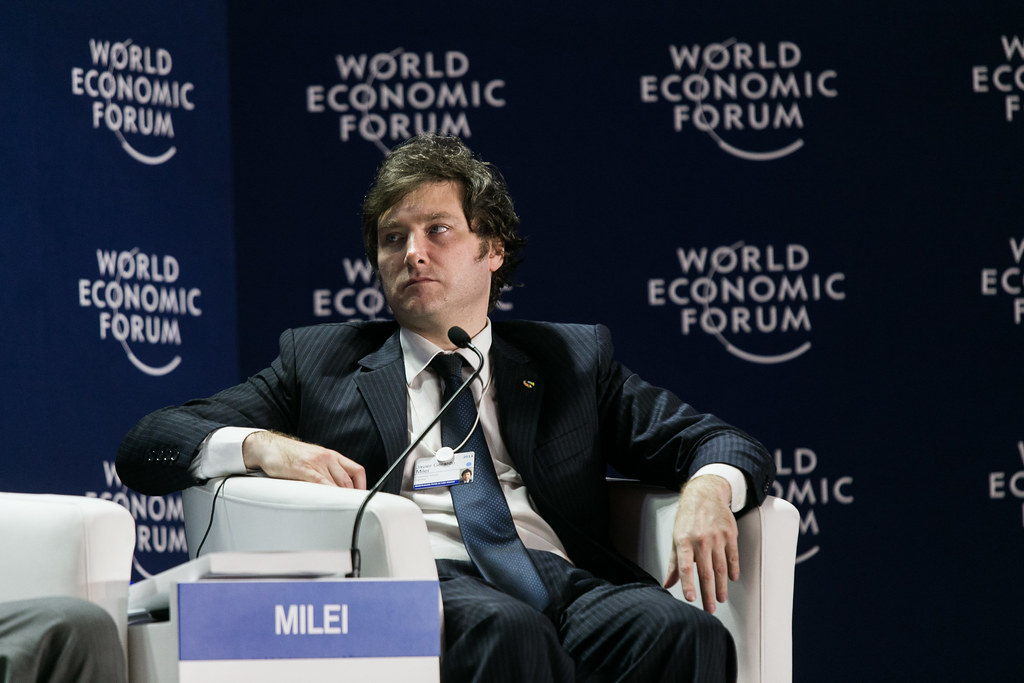
Featured image description: Javier Milei at the World Economic Forum in Davos.
Featured image credit: @Jmilei via X.