
Buenos Aires, Argentina – Argentine President Javier Milei ramped up his rhetoric over the disputed Falklands Islands – known as the Malvinas in Spanish – during his UN address last week.
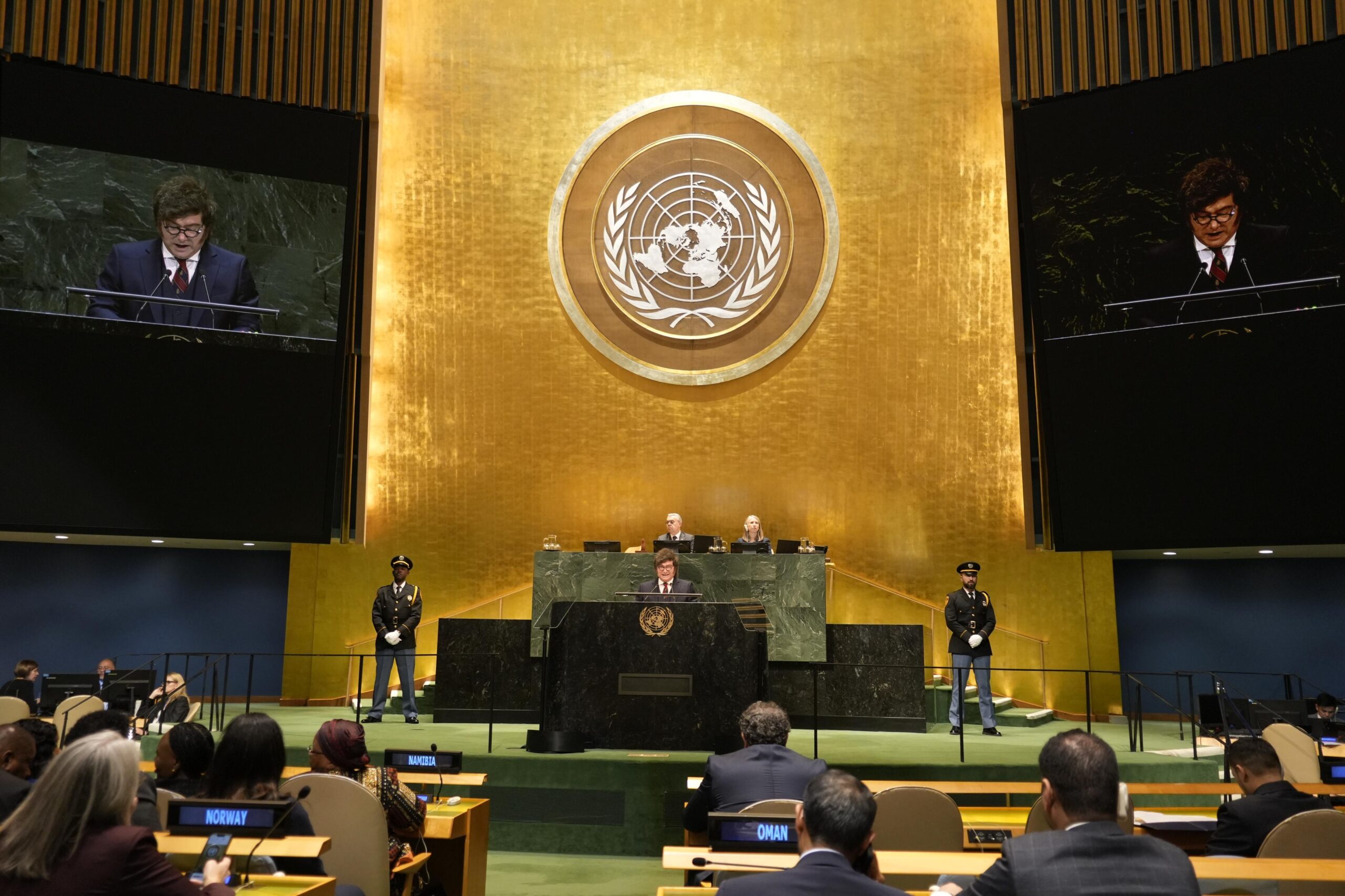
Milei focused his speech at the 81st session of the United Nations General Assembly on the British-controlled territory, which has been at the heart of a long-standing dispute between Argentina and the United Kingdom.
His declarations followed weeks of escalating diplomatic tensions with London over a multi-billion-dollar oil project in the South Atlantic Island which Argentina argues is illegal under international and national law.
Milei used seven of the twenty minutes of his speech to address the issue of the Falklands, which have been controlled by the UK since 1833 and were the site of a war with Argentina in 1982.
He accused the UN of having “looked the other way” and failing to enforce its own resolutions, referring to the Falklands as a central example of what he called the body’s “incapacity.”
The President invoked UN Resolution 3149, from 1976, which calls on both countries to refrain from unilateral changes to the islands’ status while the sovereignty dispute remains open, including the exploitation of natural resources.
“What good is a resolution if for decades the other party can act in the opposite direction and that resolution remains intact in the archives, but powerless against reality?” Milei told the General Assembly.
He used the resolution to challenge oil exploration licensed by the Malvinas’ local British administration, ahead of the planned start of offshore production next year at the Sea Lion field, located in the northern part of the islands, in the North Malvinas Basin, which is expected to produce at least 1.7 billion barrels of oil.
“There is no shortage of words or resolutions. What is missing is that they have consequences.” He repeated Argentina’s claim to the islands, adding: “We’re choosing a peaceful, practical and effective defense,” Milei added.
For Juan Rial, a professor of International Law at the National University of La Plata, the UN General Assembly has historically been the best “sounding board” for Argentine presidents to raise the Malvinas issue.
“Historically, Argentine presidents have used this forum to invite the United Kingdom to resume the dialogues that were very fruitful in the 1960s,” he told Argentina Reports.
Regarding Milei’s speech, Rial explained that UN Resolutions 3149 and 379 “establish that unilateral measures should not be adopted on the islands that modify the situation.”
He also pointed to Resolution 2065 (1965), which recognized a sovereignty dispute between Argentina and the UK and called on both countries to resume negotiations, “taking into account the interests of the islanders but not their wishes”.
He described Malvinas as a “particular” case within the UN Decolonization Committee, following the expulsion of Argentine authorities in 1833 and their replacement by British settlers, according to Argentina’s version.
He also described the Libertarian government’s approach as “strikingly hard-line”, particularly given Milei’s previous admiration for Margaret Thatcher and declaration he would seek an “adult relation” with London, including the possibility of an official visit.
Sanctions against companies
Earlier this month, Argentina’s government hardened sanctions against more than 60 companies and individuals linked to the offshore drilling project led by British-Israeli consortium Rockhopper Navitas Petroleum.
Following Milei’s speech, UK Prime Minister Andy Burnham mentioned the dispute in his own address, saying he “spoke about” it with U.S. President Donald Trump during their bilateral meeting.
“We will defend the right of the Falkland Islanders to self-determination and to remain British,” Burnham told reporters.
Milei’s speech came just weeks after Trump, a close ally, suggested Washington could reconsider its traditionally neutral position on the dispute, a shift Rial linked to broader U.S. strategic interests in the region, including pressure on London over basing rights against Iran and NATO defense-spending commitments.