


Buenos Aires, Argentina – Argentina has filed a lawsuit against the United Kingdom at the International Tribunal for the Law of the Sea to try to halt a planned oil drilling project in the Malvinas/Falklands Islands scheduled for January 2027.
On October 13, President Javier Milei formally authorized the complaint over the offshore Sea Lion project, led by the British administration of the South Atlantic Islands, after the ultimatum it had given London expired.
The legal action follows heightened tensions between the UK and Argentina – which both claim the islands – after Milei announced sanctions against companies exploiting the islands’ resources in August.
The multimillion offshore project is located 220 kilometers from the Malvinas/Falkland Islands and 400 kilometers from Santa Cruz province in mainland Argentina.
The field was discovered in May 2010 by the British company Rockhopper Exploration and the British administration on the islands authorized its extraction, with London’s backing, in late 2025. The project is led by Israeli company Navitas Petroleum, responsible for 65% of the venture.
The legal arguments
In a legal filing seen by Argentina Reports, the Argentine government asked the Hamburg-based international court to issue a precautionary measure in an attempt to stop the beginning of extraction as part of Sea Lion.
Argentina clarified that it is not asking the court to decide who owns the continental shelf – given it is outside its power to decide – but rather to preserve its resources and prevent oil from being extracted while the sovereignty dispute remains open.
According to Marcelo Kohen, an international law expert and professor emeritus at the Institute of Higher International Studies in Geneva, the Argentine legal claim is “historic”.
“It is the first time in history that Argentina decides to sue the UK for its activities in the Malvinas. The only precedent is the Argentine proposal for arbitration in 1884 that the UK rejected,” he told Argentina Reports.
The Argentine legal argument is based, among other rules, on UN General Assembly Resolution 31/49, adopted in 1976, which addressed oil exploration authorized by the British administration.
“In 1976 the UN General Assembly asked the parties to refrain from ‘taking unilateral measures’ while the decolonization process was unfolding, precisely because the UK had sent a mission to assess oil exploitation,” Kohen explained.
The filing also refers to Resolution 2065, adopted by the General Assembly in 1965, which recognizes the Malvinas/Falklands sovereignty dispute as a “particular case of decolonization”. Unlike other decolonization cases, it calls for a negotiated solution between Argentina and the UK, taking into consideration the interests of the islanders.
The issue dates back to 1833, when British forces expelled the Argentine authorities from the island. Argentina also alleges that British forces expelled the civilian population, something the UK denies.
In 1982, Argentina’s attempt to reclaim the islands through force led to a bloody conflict with the UK, which maintained its control of the territory.
But the war did not alter the nature of the sovereignty dispute, as established by UN General Assembly Resolution 37/9.
At this year’s UN General Assembly, Milei accused the body of not acting on the question of the disputed islands.
London meanwhile upholds the principle of “self-determination” for the islanders and recently announced a package of measures to shield companies that could be affected by Argentine sanctions.
Following the court filing on Tuesday, Uma Kumaran, Parliamentary Under-Secretary of State for Overseas Territories and the Caribbean, accused the Argentine government of “economic coercion” against the islanders. “We will do whatever it takes to support them,” she said at the House of Commons.
The court’s decision is due in December, a month before the drilling starts.
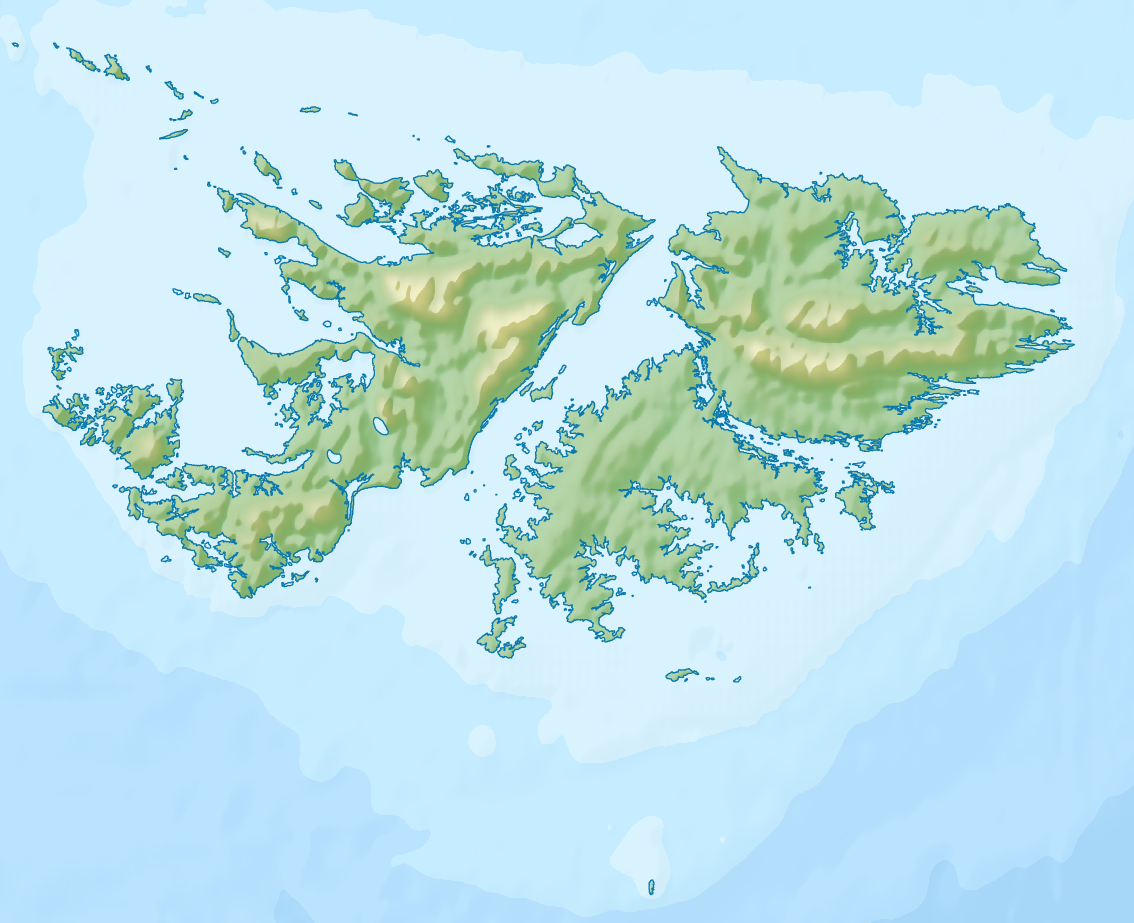
Featured image description: Relief Map of Falkland Islands.
Featured image credit: Wikimedia Commons.